Tuesday, April 21, 2009
Has Twitter Jumped the Shark?

Monday, April 13, 2009
Businesses Can Finally Yelp Back

Yelp, a recommendation website based on user reviews for everything from restaurants to dentists, is now (finally) making overtures to the business community. Starting this week, Yelp is changing a long-standing policy that will allow businesses to publicly respond to reviews. In the past, businesses could only contact the reviewer directly and beg them to change/delete the review. This approach has had varying degrees of success. As some businesses discovered, these reviews carry significant weight. Consider this: Online users prefer consumer reviews, 53%, to expert reviews, 40%, and traditional advertising, 11%. (Jupiter Research / Bazaar Voice Survey, Online Consumer Opinions/Use of User Generated Content, January 2008).
The impact of negative user reviews and the lack of a voice on Yelp has been a growing concern to businesses. In some cities, particularly mine (San Francisco), the relationship between Yelp and local businesses has been contentious and strained. So this shift in policy is welcome news to businesses. And as a Yelp user, I welcome this change because I can now get the whole story.
So if you own a business, what does this mean for you? In short, it means a lot. Here are three steps that you should take:
1) If your business is listed on Yelp (or any other website driven by user reviews), you need to follow very closely what people are saying about your business. You should know the following: the average rating for your business, the average rating for your competitors, the rating trend line for your business as well as your competitors, and the reviewers writing negative reviews.
2) If someone writes a scathing review of your product/service, reach out to that person directly. Ask for additional information about their experience and how your business could improve. Do not get defensive. Also, ask the reviewer how you can make it up to them. If you run a restaurant, you may want to provide a 25% off coupon or a free bottle of wine for the reviewers next visit. A chiropractor might offer a free session. If you offer a sincere apology and a way to make amends, the person will most likely change their review. The reviewer may do this in a variety of ways: by increasing the star rating, by providing an update to the review or by simply deleting the previous review. Some will refuse to make any changes. If you are dealing with one of those people, go to step 3.
3) Publicly respond to the critic. Do not attack the person. Correct any factual errors. Tell the world how you tried to rectify the problem. Even if the reviewer doesn't change their rating of your business, your response could lessen the fall-out from a negative review.
Any other suggestions you would offer to businesses on how to manage Yelp?
Tuesday, April 7, 2009
What's the Difference Between Web 1.0, 2.0 and 3.0?
Web 1.0: "The Information Web". Content is mostly static, not dynamic. Companies started creating websites, which were basicially digitized brochures. Mostly one-way and one-to-many communication pattern (similar to ads on television). Finding information or determing which products/services to purchase involves search engines (Google, Yahoo etc.) or specific websites offering "expert" opinions.
Web 2.0: "The Social & Personal Web". People wanted to contribute and technology made it easier to do so. As a result, Blogging, Podcasts, Wikis and social sites became popular. Interactive features, such as comment boxes and voting widgets started springing up everwhere. Finding information or determining which products/services to purchase involves looking at recommendation sites based on "the crowd's opinion" (such as Yelp and TripAdvisor) and asking friends through social sites (Facebook, MySpace etc.).
Web 3.0: "The Semantic Web". Basically, it's Web 2.0 on steroids. As more and more people join an ever expanding array of social networks, easily managing all of those networks becomes crucial. Companies are starting to offer solutions for this problem, such as push-button updates (i.e. you update your status once and it populates this information across all of your social networks at the same time).
While the world wide web is rapidly evolving, Web 3.0 won't necessarily kill off what came before. We will still be Googling for a long time to come.
Wednesday, April 1, 2009
Darwinism on the Web: Surviving & Thriving in a Web 2.0 World

That catchy title isn't my own, but rather one of the topics being discussed at the Web 2.0 Expo I am attending in San Francisco (March 31-April 3rd). Thought I'd share a condensed version of the learnings with everyone who couldn't attend. The discussion was led by Soren Stamer of Coremedia.
Like the Dodo bird, businesses are in danger of extinction due to the rapid evolution of disruptive technologies, specifically Web 2.0. Soren asserts that there are several things a company must do to avoid that fate. Here are a few ideas mentioned in the session that will enable a company to not only survive, but also to thrive.
Also, there are still two days left for the Expo. If you're in the San Francisco Bay Area, click here to find out how you can score free tickets:
http://www.web2expo.com/webexsf2009/public/content/free
Friday, March 27, 2009
My New Twitter Obsession

Sunday, March 22, 2009
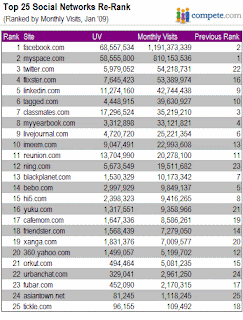
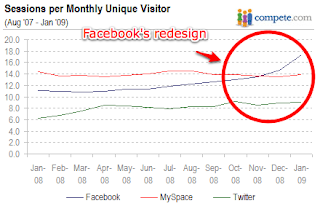
Social Networking Stats -- Facebook & Twitter Rising, Myspace Declining